Secret Library Scenes Junk Journal Pages: A Designer's Take
There's a certain magic to old libraries—the scent of aging paper, the quiet hum of knowledge, the intricate details on forgotten book covers. Capturing that essence for a creative project used to require hours of hunting through flea markets or risky scanning of antique books. The Secret Library Scenes Junk Journal Pages collection offers a direct line to that aesthetic, providing a toolkit of high-quality, printable scenes designed to infuse your work with narrative depth and vintage charm. As someone who works with design assets daily, I find these pages less like simple backgrounds and more like foundational layers for storytelling.
Beyond the Background: The Visual Language of the Collection
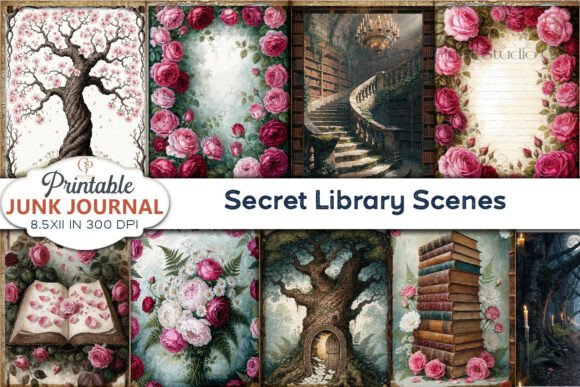
At its core, this is a set of 10 distinct JPEG files, each sized at a standard 8.5 x 11 inches and rendered at 300 DPI. This technical spec is crucial—it means the files are ready for high-quality printing without pixelation, a common pitfall with lower-resolution digital assets. But the real value lies in the visual personality. These aren't generic, clean-lined graphics. They carry the texture of actual library scenes: think weathered wood grain, faded ink illustrations, subtle paper stains, and the soft, muted color palette of aged parchment and leather.
This style is inherently serif in its feeling—rooted in tradition, detail, and a sense of established authority. It’s the visual opposite of a sleek, sans serif corporate aesthetic. The appeal is in its authenticity and the immediate sense of history it conveys. For a crafter building a junk journal, these pages solve the most significant hurdle: creating a cohesive, richly layered starting point. For a designer, they serve as a powerful creative font of visual elements, offering more complexity and warmth than a standard display font or script font could provide alone.
Where These Scenes Find Their Home: Practical Applications
The versatility of the Secret Library Scenes Junk Journal Pages is one of its strongest assets. Its primary function is, of course, within paper crafts. They become the very fabric of scrapbooking layouts, the layered backgrounds for collage art, and the thematic heart of DIY creative projects like handmade cards or altered books. The instant download nature means your creative flow isn't interrupted by shipping times.
However, thinking of these purely as physical craft supplies limits their potential. In the digital realm, they are exceptional for:
- Brand Identity & Packaging: A boutique tea company, a vintage bookstore, or a whiskey brand could use these scenes as textured backgrounds on packaging or within their brand style guide to evoke a sense of heritage and craftsmanship. Paired with a complementary typeface, they help build a complete brand identity.
- Editorial & Web Design: Bloggers and publishers focusing on literature, history, or lifestyle topics can use these as hero image backgrounds, chapter dividers in digital PDFs, or subtle website textures. They add a layer of sophistication that stock photos often lack.
- Social Media & Marketing: For content creators, these pages are gold. Use them as backgrounds for quote graphics, podcast episode art, or Instagram story frames. They instantly set a mood—thoughtful, intellectual, nostalgic—that generic templates can't match.
Integrating the Aesthetic: A Guide for Makers and Designers
Simply dropping one of these pages into a project isn't enough. The key to success is intentional integration. First, consider font pairing. Because the scenes are rich and textured, your typography needs to balance them. A clean, modern sans serif for body copy can provide excellent readability and contrast against the ornate background. For headlines, a refined serif or an elegant handwritten font can echo the vintage feel without becoming illegible.
Think about visual hierarchy. Use a full scene as a background and place a lighter, semi-transparent layer over it to hold your text, ensuring readability. Crop the scenes to use specific elements—a shelf of books, a reading lamp—as focal points. This approach influences audience engagement by creating points of interest and guiding the viewer's eye through your composition.
Finally, understand the licensing. This is a commercial font and asset collection, meaning it's cleared for both personal and commercial projects. This is vital for entrepreneurs and small business owners who need to use assets in products for sale. The premium font quality (in terms of resolution and design) justifies its use in professional logo design elements, packaging design, and client work. Always review the specific license terms, but the "ready to print digital files" descriptor typically signals broad usability.
In a world saturated with flat design and minimalism, the Secret Library Scenes Junk Journal Pages offer a welcome return to texture, story, and tangible history. They are a foundational design asset for anyone whose work benefits from a touch of the mysterious and the well-loved. They don't just decorate a page; they suggest a world exists just beyond its edges.